
China’s Focus on Sustainable Transportation Heats Up

China's aggressive advancement of regulations and sustainability measures to reduce transportation emissions signifies a decisive stride toward its environmental goals.
These measures are:
- Increasing stringency of corporate average fuel consumption policy to decrease vehicle tailpipe emissions.
- Introducing a dual-credit framework for new energy vehicles to raise the adoption of electric vehicles.
- Developing a China Circular Economy Plan focused on battery recycling.
- Enforcing interim regulations for carbon emission trading.
- Promoting the issuance of green bonds to support sustainable finance endeavors.
Mainland China, as the largest global emitter of greenhouse gases, pledges carbon neutrality by 2060, a commitment critical to the global effort to limit global warming under the Paris Agreement goals. This endeavor aims to keep the rise in global temperature below 2 degrees Celsius, ideally 1.5 degrees. A pivotal aspect of this effort involves transitioning the transportation sector to low-carbon alternatives, given its significant contribution to emissions within China.
China transport sector decarbonization
The transportation sector accounts for over 27% of China's total greenhouse gas emissions, with projections estimating it will reach its emission peak between 2025 and 2035 — potentially even earlier if policies are implemented effectively, possibly before 2030. Through initiatives such as vehicle electrification and enhancements in fuel efficiency, emissions could decline by 50%-95% from 2020 levels by 2060. The transport sector also accounts for 20%-50% of PM2.5 emissions in cities and is a major emitter of nitrogen oxides (NOx) and volatile organic compounds (VOCs) nationwide.
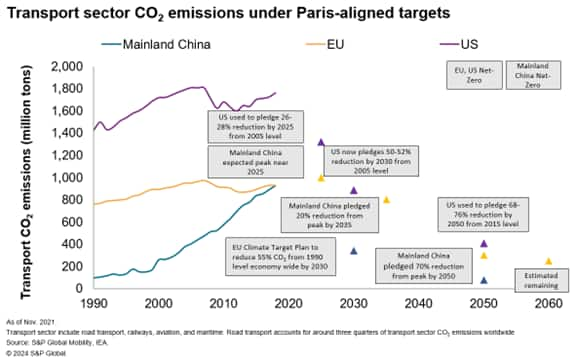
Concurrently, China is also tightening controls on coal use, enhancing non-fossil energy sources and halting new overseas coal projects, reflecting its commitment to environmental sustainability. Moreover, an investment of over $546 billion in 2022 was made for new energy technologies, indicating its push for a sustainable shift in energy and industry.
Read S&P Global Mobility's whitepaper for an in-depth analysis on mainland's China's 5 goals for sustainable transport.
This article was published by S&P Global Mobility and not by S&P Global Ratings, which is a separately managed division of S&P Global.