Customer Logins
Obtain the data you need to make the most informed decisions by accessing our extensive portfolio of information, analytics, and expertise. Sign in to the product or service center of your choice.
Customer Logins


ECONOMICS COMMENTARY
Mar 04, 2026
Global manufacturing input prices rise at fastest rate since 2022

Global manufacturing input costs rose in February at the sharpest rate since 2022 as supply chain bottlenecks added to upward pressure on prices from higher labour costs and US tariffs. Higher energy prices and further supply disruptions from the Iran war look likely to add further pressure to producer price inflation in March.
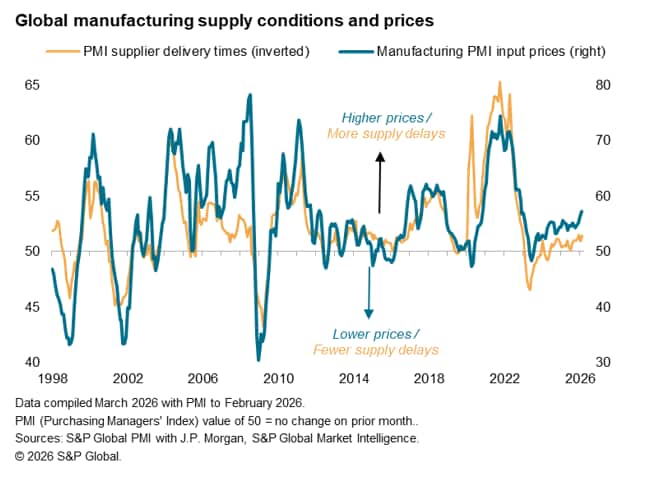
Manufacturing prices rise at fastest rate since 2022
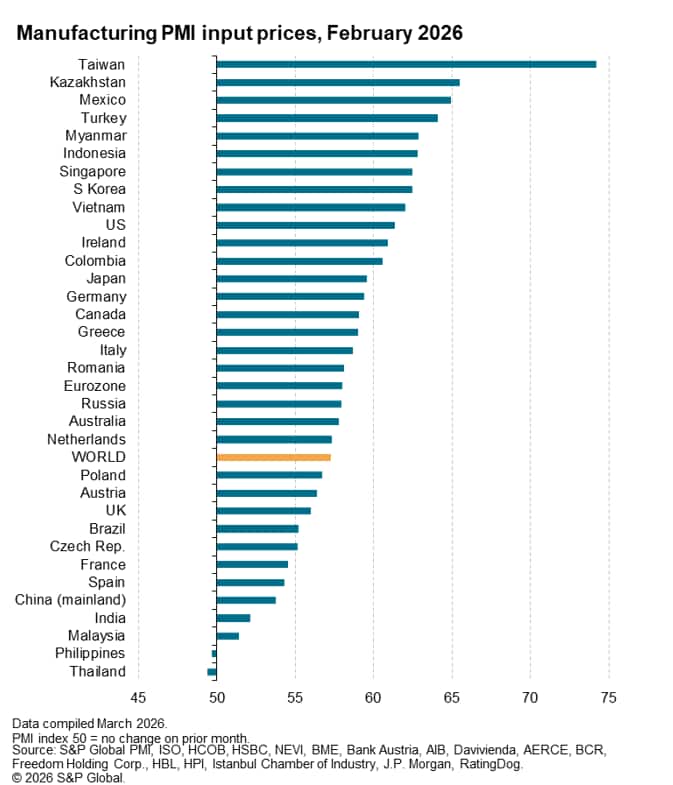
Global manufacturing input prices rose in February at the sharpest rate since November 2022, according to PMI data sponsored by J.P. Morgan and compiled by S&P Global Market Intelligence.
The global manufacturing PMI input prices index, for which any reading above 50 signals an increase in prices on the prior month, rose from 56.4 in January to 57.3, indicating an acceleration of worldwide factory input cost inflation for a fourth successive month.
Only two economies - Thailand and the Philippines - reported lower factory input costs in February, while the largest increase by far was reported in Taiwan, linked by many purchasing managers to demand exceeding supply, causing a lengthening of supplier lead times.
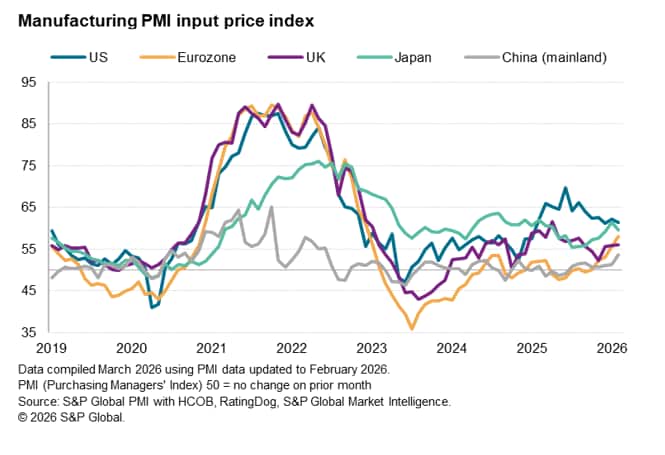
Prices in mainland China rose at the sharpest rate since June 2022, contributing to the steepest rise in pan-Asia prices since October 2022. Eurozone input cost inflation hit the highest since December 2022 and US prices also continued to rise sharply, albeit the rate of increase down from 2025 highs, often blamed on tariffs.
Supply delays
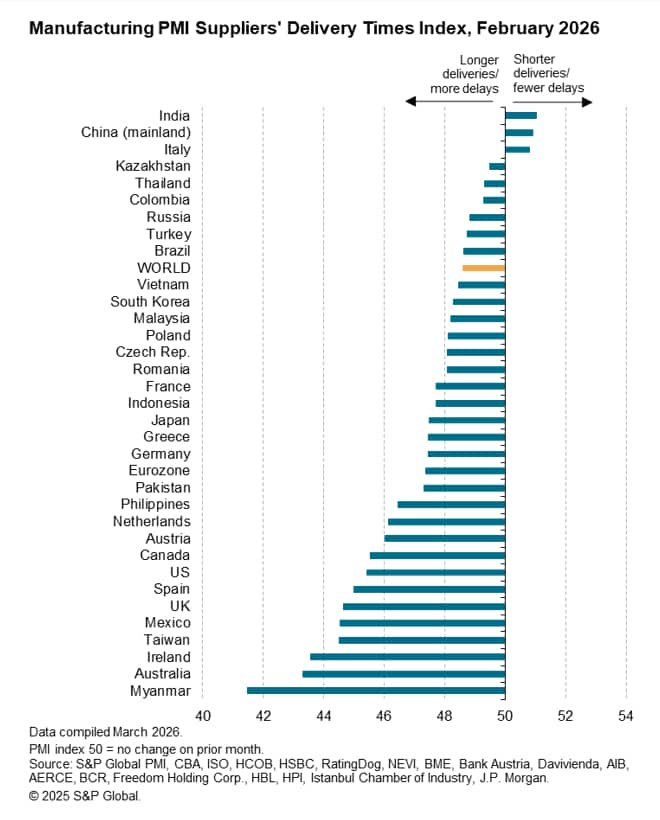
The rise in global prices also coincided with a lengthening of suppliers' delivery times worldwide to one of the greatest extents since the pandemic-related supply constraints of 2022.
Only three economies - India, mainland China and Italy - reported faster delivery times in February. The longest/most widespread delays were seen in Myanmar and Australia. However, delays across Asia excluding mainland China have risen to the highest since January 2023, and recent months have seen delays in Europe extending out to their greatest since 2022. While US delays were also the most pronounced since 2022, this was in part due to adverse weather.
Price impact outlook to depend on duration of MENA conflict
While supplier delivery times have lengthened, the overall incidence of delays remains far lower than seen during the COVID-19 shutdowns. However, the PMI data for February were collected prior to the US-Israeli attacks on Iran and the ensuing escalation of conflict in the Middle East.
Since the attacks, energy prices have risen sharply and supply chains have been disrupted, notably via concerns over attacks on shipping through the Strait of Hormuz. We note that, according to comments from PMI contributors in the February survey, the rise in manufacturing costs was neither a reflection of energy prices nor shipping costs, suggesting these factors could add to inflation pressures in the March survey, exacerbating the existing price drivers of rising labour costs and a broader rise in raw material prices.
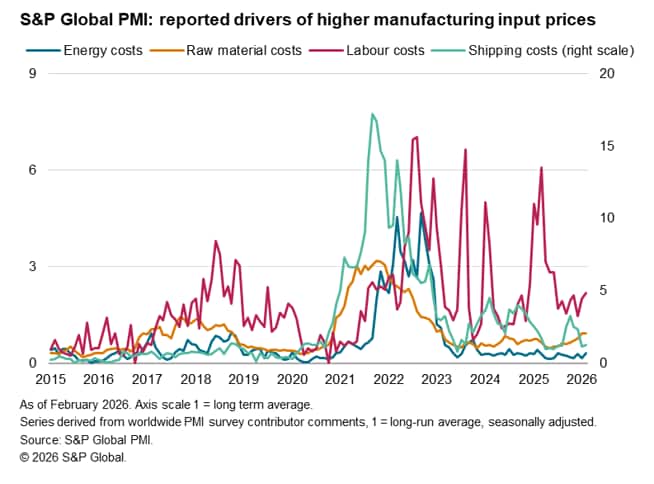
For example, as the war moved into its third day, our shipping experts report that about 10% of the global container shipping fleet was either stranded inside the Persian Gulf or held up outside.
Oil prices are meanwhile up one-third on the start of the year at the time of writing, while liquid natural gas prices have risen 50% due to the crisis.
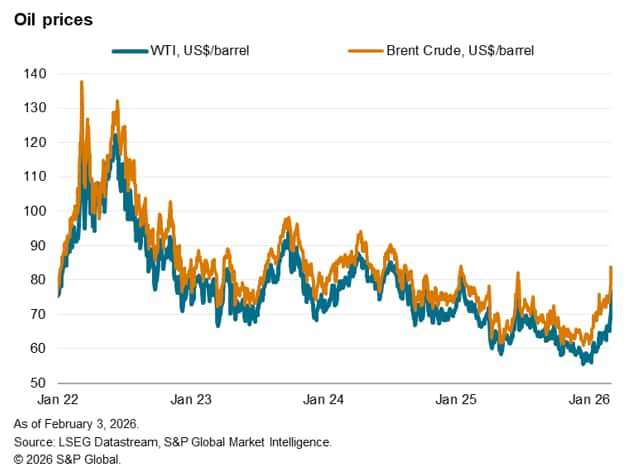
Much of the price and supply impact will clearly depend on the duration of any conflict in the Middle East, and S&P Global Connect users can also access our regular updates on the situation from our risk experts via the MENA regional conflict pages.
The extent to which the conflict is causing supply-driven price rises can be meanwhile tracked through the PMI supplier's delivery times index and price gauges, as well as through the PMI Comment Tracker database, which are updated monthly.
Read more about how to interpret the PMI Suppliers' Delivery Times Index here.
Access the latest global PMI press release here.
Chris Williamson, Chief Business Economist, S&P Global Market Intelligence
Tel: +44 207 260 2329
© 2026, S&P Global. All rights reserved. Reproduction in whole
or in part without permission is prohibited.
Purchasing Managers' Index™ (PMI®) data are compiled by S&P Global for more than 40 economies worldwide. The monthly data are derived from surveys of senior executives at private sector companies, and are available only via subscription. The PMI dataset features a headline number, which indicates the overall health of an economy, and sub-indices, which provide insights into other key economic drivers such as GDP, inflation, exports, capacity utilization, employment and inventories. The PMI data are used by financial and corporate professionals to better understand where economies and markets are headed, and to uncover opportunities.
This article was published by S&P Global Market Intelligence and not by S&P Global Ratings, which is a separately managed division of S&P Global.
{"items" : [
{"name":"share","enabled":true,"desc":"<strong>Share</strong>","mobdesc":"Share","options":[ {"name":"facebook","url":"https://www.facebook.com/sharer.php?u=http%3a%2f%2fprod.azure.ihsmarkit.com%2fmarketintelligence%2fen%2fmi%2fresearch-analysis%2fglobal-manufacturing-input-prices-rise-at-fastest-rate-since-2022-Mar26.html","enabled":true},{"name":"twitter","url":"https://twitter.com/intent/tweet?url=http%3a%2f%2fprod.azure.ihsmarkit.com%2fmarketintelligence%2fen%2fmi%2fresearch-analysis%2fglobal-manufacturing-input-prices-rise-at-fastest-rate-since-2022-Mar26.html&text=Global+manufacturing+input+prices+rise+at+fastest+rate+since+2022+%7c+S%26P+Global+","enabled":true},{"name":"linkedin","url":"https://www.linkedin.com/sharing/share-offsite/?url=http%3a%2f%2fprod.azure.ihsmarkit.com%2fmarketintelligence%2fen%2fmi%2fresearch-analysis%2fglobal-manufacturing-input-prices-rise-at-fastest-rate-since-2022-Mar26.html","enabled":true},{"name":"email","url":"?subject=Global manufacturing input prices rise at fastest rate since 2022 | S&P Global &body=http%3a%2f%2fprod.azure.ihsmarkit.com%2fmarketintelligence%2fen%2fmi%2fresearch-analysis%2fglobal-manufacturing-input-prices-rise-at-fastest-rate-since-2022-Mar26.html","enabled":true},{"name":"whatsapp","url":"https://api.whatsapp.com/send?text=Global+manufacturing+input+prices+rise+at+fastest+rate+since+2022+%7c+S%26P+Global+ http%3a%2f%2fprod.azure.ihsmarkit.com%2fmarketintelligence%2fen%2fmi%2fresearch-analysis%2fglobal-manufacturing-input-prices-rise-at-fastest-rate-since-2022-Mar26.html","enabled":true}]}, {"name":"rtt","enabled":true,"mobdesc":"Top"}
]}